


"Nigeria Must Go" Protest Set for July 19 2025 Across Ghana
- Admin
- Jul 18, 2025
- 4 min read
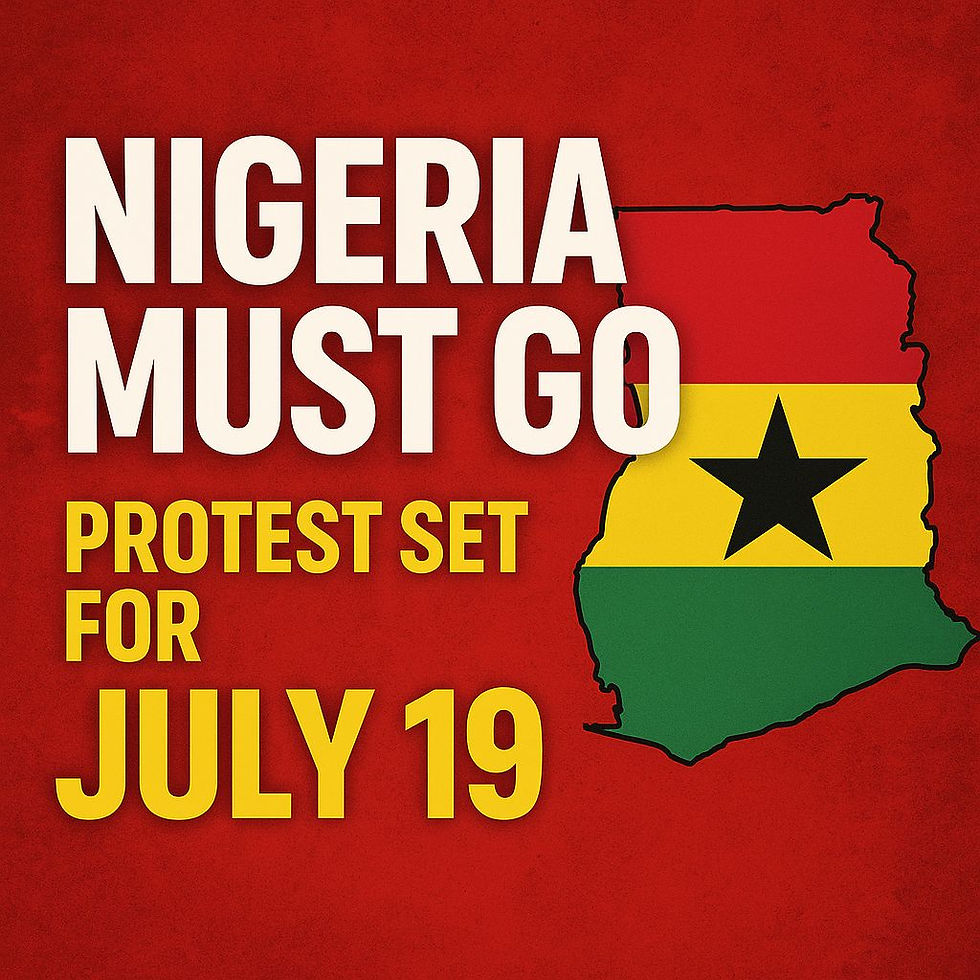
On Saturday, July 19, 2025, Ghana will witness what could become a pivotal moment in West African relations: the “Nigeria Must Go” protest, a nationwide campaign sparked by growing frustration over cultural sovereignty and traditional authority. While protesters insist the movement is not rooted in xenophobia, the tensions it has unearthed cut deeply into issues of identity, governance, and regional cooperation.
Most importantly, the protests threaten to reignite historical fractures between Ghana and Nigeria, potentially undermining the very foundation of African unity and economic integration particularly the vision of a United States of Africa (USAfrica).
But beyond the cultural debates, the looming question remains: What are the economic implications of this protest, and how could it impact the broader African economy?
Historical Echoes: “Ghana Must Go” Reversed?
The slogan “Nigeria Must Go” is an ironic echo of the 1983 Nigerian expulsion of over one million Ghanaians, a moment immortalized in the now-infamous "Ghana Must Go" bags. That historical episode damaged diplomatic ties and sowed deep social and economic scars. Now, over four decades later, the roles appear reversed not just symbolically, but in real economic and political terms.
This time, Ghanaian protesters are demanding the deportation of Nigerians, particularly targeting individuals like Eze Chukwudi Jude Ihenetu, a self-proclaimed “Igbo King” in Ghana. The Ga Traditional Council has publicly disowned him, calling his claim to a traditional title within Ghana illegitimate. The protestors’ key demands include:
A government ban on foreign-styled chieftaincies
Deportation of non-Ghanaians asserting traditional leadership
Stricter enforcement of cultural and property laws by national agencies
Economic Fallout: How Cultural Tensions Threaten Regional Growth
Ghana and Nigeria, West Africa's two largest economies, enjoy deeply intertwined trade, migration, and business ties. A breakdown in diplomatic and social cohesion could disrupt regional trade flows, displace communities, and erode investor confidence across ECOWAS. Here’s how:
1. Regional Trade and Investment
Nigeria is one of Ghana's largest trading partners. According to ECOWAS data, intra-African trade has been growing steadily under the African Continental Free Trade Area (AfCFTA), with Ghana and Nigeria as key players. Many Nigerian businesses operate in Ghana, from fintech startups to large-scale retail and oil servicing companies. If the protest fuels anti-Nigerian sentiment or leads to deportations:
Ghana could face retaliatory trade policies from Nigeria.
Nigerian-owned businesses may shut down or relocate, affecting employment and tax revenues.
Bilateral trade worth hundreds of millions of dollars annually could plummet.
2. The Informal Economy
A significant portion of Ghana’s informal economy is powered by migrant communities, including Nigerians. Nigerian traders are especially visible in Accra, Kumasi, and Tema markets. These micro-entrepreneurs:
Create thousands of jobs for locals directly and indirectly.
Contribute to local supply chains in agriculture, retail, and services.
Stimulate demand in urban and peri-urban areas.
Targeted deportations or the perception of hostility could displace informal workers, disrupt supply chains, and create urban economic shocks.
3. Real Estate and Housing
Ghana’s housing crisis is exacerbated by poor regulation, and migrants are often blamed for driving up rents. However, this is a structural issue, not one caused solely by Nigerians. The protest’s call for stronger Rent Control enforcement is fair, but blanket accusations risk:
Scaring away foreign property investors, many of whom are from Nigeria.
Creating housing instability for thousands of tenants.
Triggering asset flight if wealthy Nigerians begin offloading real estate holdings.
The Dream of United States of Africa: Undermined?
The protests present a fundamental contradiction in Africa’s political imagination. Can we truly talk of a “United States of Africa” while individual countries erupt in nationalist, anti-immigrant sentiment?
The African Union’s Agenda 2063 envisions a continent where borders are blurred economically, politically, and culturally. Yet, events like this protest expose deep-rooted tribalism, nationalism, and protectionism that continue to fracture this vision.
Key Threats to African Unity:
Cultural nationalism overriding regional integration.
Failure to establish continental legal frameworks on migration, dual identity, and chieftaincy rights.
Populist movements exploiting economic frustration to scapegoat immigrants.
If Ghana and Nigeria two of Africa’s most powerful nations cannot resolve these disputes amicably, the broader vision of African unity becomes rhetoric without structure.
Policy Blind Spots and Governance Failures
While protesters argue the movement is not xenophobic, the government’s handling of chieftaincy disputes and immigration has been poorly coordinated. This has allowed misinformation, tension, and radicalism to fester.
What Governments Must Do:
Clarify Legal Status of Foreign Traditional Authorities There must be a continental dialogue (perhaps AU-led) on the role and recognition of migrant cultural leaders across African borders.
Establish Cultural Integration Protocols With millions of Africans living outside their home countries, there’s a need for soft-diplomacy frameworks to manage cultural frictions.
Strengthen ECOWAS Conflict Resolution Mechanisms ECOWAS must not wait for a diplomatic crisis to intervene. The institution needs to become more proactive in de-escalating social tensions that could impact economic integration.
Launch Public Education Campaigns Both Ghana and Nigeria need to educate their citizens on the mutual benefits of migration, cultural exchange, and pan-Africanism rather than allow isolated events to shape national discourse.
Social Media and Misinformation
The protest has been amplified by social media outrage, much of which lacks nuance. Viral videos, false attributions, and ethnocentric slurs are increasing polarization. This raises the stakes for cyber diplomacy, where both governments must monitor and regulate digital hate speech that could incite violence or economic sabotage.
Conclusion: The Streets Will Speak, But What Will Africa Hear?
The July 19 “Nigeria Must Go” protest is more than a cultural spat it's a litmus test for how Africa handles internal diversity within a borderless future. If Ghana and Nigeria fail to resolve this peacefully, the economic consequences will be felt not just in Accra or Lagos, but across the entire African integration project.
As the streets speak, Africa must listen not with fear or retaliation, but with bold, collaborative action that upholds cultural dignity, economic unity, and pan-African ideals. Because if we cannot coexist within our own borders, how can we ever unify across them?
Call to Action:
To African Union: Convene an urgent roundtable on the legal harmonization of cultural leadership and migration rights.
To ECOWAS: Issue a joint communiqué to de-escalate tensions and support peaceful protest while protecting bilateral relations.
To Youth and Civil Society: Advocate for peaceful dialogue, reject xenophobia, and demand structural reforms, not scapegoats.
Africa's strength lies in her unity but unity begins with mutual respect.


Comments